

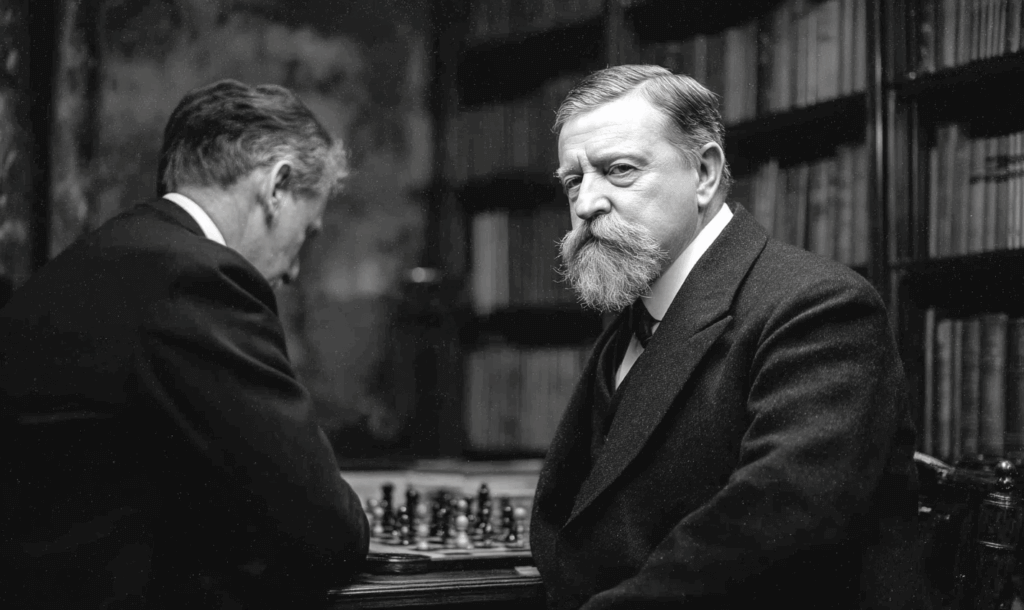
History Chapter: Two Roads Diverged
Most people don’t realize this, but the modern world was born from a quiet divorce in the way we approach understanding reality. This separation, which has profoundly shaped the way we think about ourselves, science, art, and even branding, happened during the Enlightenment—a time when humanity stood at the crossroads of two powerful traditions: science and rhetoric.
Science took the road that Newton laid out, a path made visible by calculus, physics, and later organic chemistry—fields so powerful they became the standard for how we believe truth should be proven. Newton’s Principia Mathematica didn’t just offer a way to understand gravity; it provided a universal template for knowledge itself. If you could measure it, reproduce it, and predict it—then it was real, substantial, valuable.
Yet even as science began to dominate our understanding of nature, another intellectual tradition persisted—one just as old, just as rigorous, and arguably far more suited to grasping human consciousness. This tradition was rhetoric, whose roots stretched back to Aristotle, who described rhetoric as “the faculty of observing, in any given situation, all the available means of persuasion.” Rhetoric, and its modern descendant semiotics, is not concerned with atoms or gravity but with signs, symbols, and meaning—those ephemeral constructs that shape human perception and culture.
The Enlightenment thus delivered us into modernity with a neatly divided intellectual heritage. On one hand, we had the positivist rigor of Newtonian physics and organic chemistry—unmatched tools for comprehending the objective natural world. On the other hand, we had the interpretive arts of rhetoric and semiotics—disciplines uniquely equipped to map the messy, subjective terrain of human consciousness.
From Rhetoric to Semiotics: The Birth of Modern Meaning
Semiotics itself, the modern theory of signs, owes its foundations to two thinkers: Ferdinand de Saussure and Charles Sanders Peirce. Saussure, the father of structural linguistics, gave us a simple, radical insight: meaning is not inherent in things themselves but arises from differences within a system of signs. A word means nothing outside its linguistic context. The color red means nothing without blue, green, or yellow to position it.
Peirce, an American pragmatist philosopher, expanded on this idea. For him, meaning emerges through interpretation—a process always evolving, never complete. In short, Peirce shifted the focus from static definitions to dynamic interpretations. These ideas may seem abstract, but they’re anything but theoretical fluff. They tell us something profound about how our minds work. Our brains aren’t passive receivers of objective truths; they’re active interpreters of signs and signals, forever constructing meaning from context.
In other words, science is powerful at telling us how the universe operates; semiotics is powerful at telling us how our minds operate within that universe. Science gives us facts. Semiotics gives us meaning.
The Limits of Science in Human Affairs
Science, particularly neuroscience and cognitive psychology, has made substantial strides in understanding the brain as an organ. Yet, it continually bumps against a fundamental barrier: human consciousness is not just neurological signals and chemical reactions. Our internal worlds are defined by signs—language, symbols, metaphors—concepts that resist reduction to mere data. Consciousness itself is semiotic. Our thoughts, desires, identities, and cultures aren’t governed by scientific laws—they’re shaped by narratives, symbols, and meanings.
While Newtonian physics excels at explaining how a ball arcs through the air, it falters when faced with why someone chooses to buy a particular brand of shoes. Organic chemistry can elegantly detail the interaction of neurotransmitters, but it cannot explain why a nation rallies around a flag or why an advertisement resonates deeply in one cultural context and utterly fails in another.
Enter Industrial Semiotics: The Future of Brand Marketing
Branding and marketing today stand at a unique juncture. The explosion of AI-driven content generation underscores this crucial point: mere content production—words, images, sound—is no longer a scarce commodity. Machines flood us with infinite content. What remains scarce and valuable is interpretative coherence: meaning, context, cultural logic.
Industrial Semiotics, the disciplined practice of structuring symbolic meaning, offers a path forward for brand marketing precisely because it capitalizes on what science cannot. It treats brands not merely as purveyors of products, but as cultural artifacts—systems of signs capable of shaping and reshaping perceptions, values, and beliefs at scale.
Unlike traditional marketing, Industrial Semiotics isn’t about more content; it’s about better framing. It focuses on the invisible interpretive frameworks consumers use, consciously or not, to decode their world. In an age of algorithmically-generated saturation, the brands that succeed will be those that master semiotic fluency—brands that understand meaning as infrastructure.
Embracing Semiotics as the Ultimate Tool
Ultimately, the debate between humanities and science is not about which is superior. Both traditions illuminate critical dimensions of reality. However, when it comes to comprehending and influencing the human mind—the seat of meaning itself—semiotics and rhetorical theory provide unparalleled tools. This interpretive tradition doesn’t just measure reality; it actively participates in creating it.
As we move deeper into an era dominated by AI, automation, and infinite content, brands will increasingly turn to semiotics. It’s not simply a choice of methodology; it’s an acknowledgment that understanding humans requires a fundamentally different toolkit than understanding nature.
Newton showed us how to master the physical world. Now, semiotics can teach us how to master the symbolic one—the realm of human consciousness and cultural logic. In that realm, Industrial Semiotics is not just useful; it’s essential.
This is an invitation to explore the profound implications of semiotics for the future of brands and how we communicate in a world where meaning, not content, is king.